
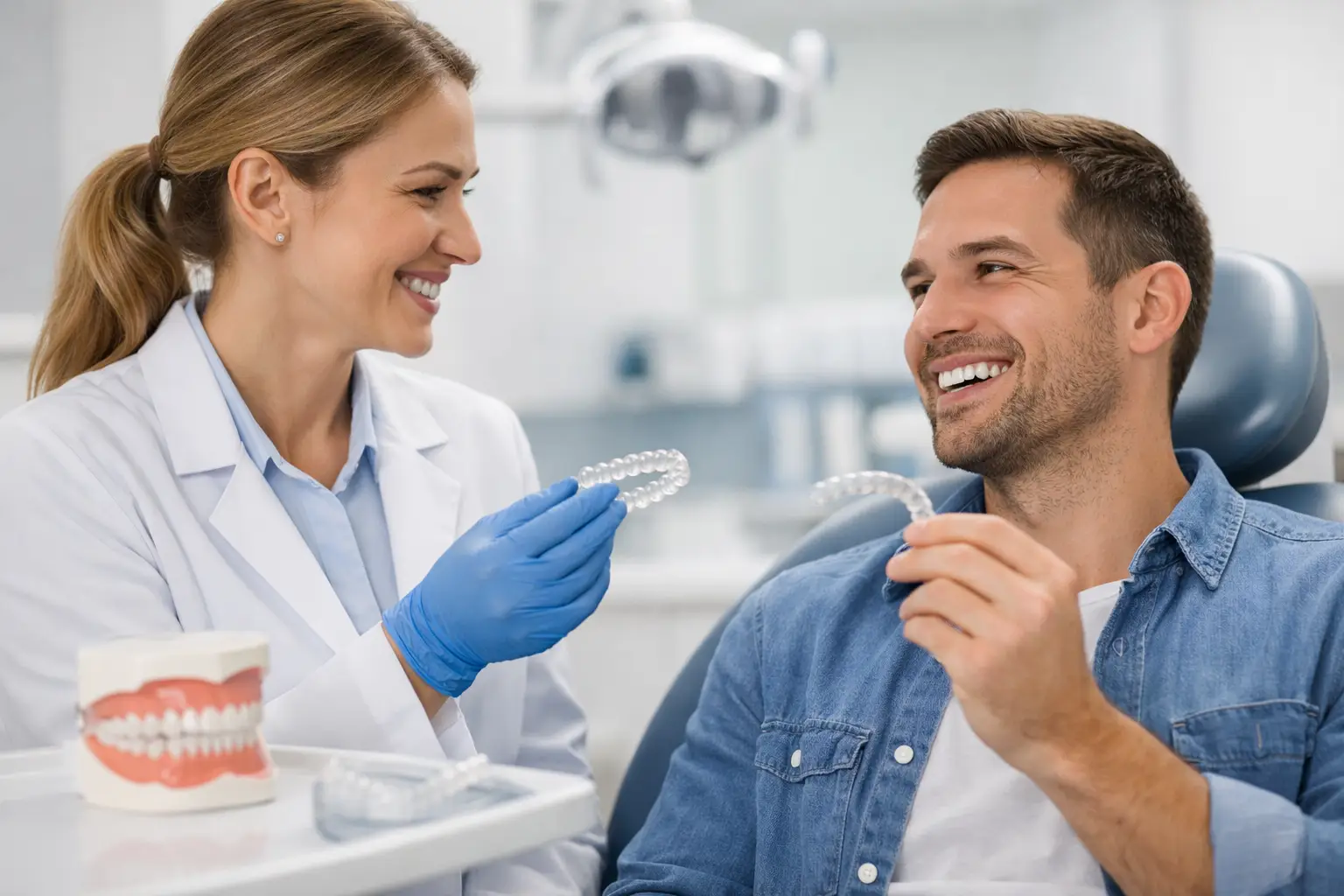
A straight smile can look impressive and still feel off when the bite is not working the way it should. That is why bite correction clear aligners have become such a meaningful advance in modern orthodontics. They do more than improve appearance. In the right case, they help guide tooth movement in a way that supports better contact between the upper and lower arches, more balanced function, and a result that feels as good as it looks.
For many adults and teens, the appeal is obvious. Clear aligners are discreet, comfortable, and easy to fit into daily life. But the real question is not whether they are convenient. It is whether they can correct the kind of bite issues that affect chewing, comfort, jaw balance, and long-term stability. The answer is often yes, with one important condition: treatment has to be planned with precision and monitored with more than surface-level tooth alignment in mind.
What bite correction clear aligners actually treat
When people hear the word bite, they often think only about overbite. In orthodontics, bite correction is broader than that. It can involve overbite, underbite, crossbite, open bite, deep bite, crowding that affects the way teeth meet, and arch relationships that place uneven stress on the teeth and jaw.
Clear aligners can be highly effective for many of these concerns because they apply controlled forces in small stages. Each tray is designed to move selected teeth by a precise amount, and across a full series, those movements can change how the entire bite comes together. Attachments, elastics, interproximal reduction, and carefully sequenced staging can all play a role in making bite correction more predictable.
That said, not every bite issue is equally simple to treat. Mild to moderate cases are often very well suited to aligners. More complex skeletal discrepancies may require a broader plan, sometimes including functional support, growth guidance in younger patients, or surgical orthodontics in severe adult cases. Precision matters, but case selection matters too.
Why straight teeth are not the same as a corrected bite
This is where many patients get confused, and understandably so. Teeth can appear aligned in photos while the bite remains unstable. If the front teeth look even but the back teeth do not support properly, or if the jaw position is not harmonized with the tooth movement, the result may be attractive without being fully functional.
A well-corrected bite is about coordination. The upper and lower teeth should meet in a way that distributes force efficiently. The arches should work together, not compete with each other. The jaw should close comfortably, without forcing the muscles to compensate.
That is why advanced aligner treatment is moving beyond cosmetic straightening alone. A premium treatment plan considers tooth position, arch form, bite contact, and jaw relationship together. This broader view can improve comfort, treatment efficiency, and the likelihood of long-term stability.
How clear aligners create bite changes
Aligners work because they are digitally planned before treatment begins. A scan captures the starting position, software maps the intended movements, and the trays are manufactured to guide the teeth through that sequence. For bite correction, this planning has to go beyond simple alignment.
For example, a deep bite may require intrusion of the front teeth, controlled eruption of posterior teeth, or both. A crossbite may need arch development and precise tipping control. An open bite may call for different staging, vertical control, and close monitoring of habits or tongue posture. These are not generic tray changes. They are highly specific biomechanical decisions.
This is where a digital-first orthodontic approach offers a real advantage. With detailed scans and progress comparisons, clinicians can assess whether movement is happening as planned and adjust early if it is not. That reduces guesswork and supports a more predictable result.
The role of jaw function in aligner-based bite correction
One of the biggest limitations in conventional orthodontic thinking is the assumption that moving teeth alone will solve every bite problem. In reality, bite function involves the entire stomatognathic system, including teeth, arches, jaw position, joints, and muscles.
When jaw dynamics are overlooked, treatment may still produce straighter teeth, but the path to that result can be slower or less stable. In some patients, synchronizing jaw function with orthodontic movement can improve efficiency and create a more balanced outcome.
This is where systems like MYSS take a more advanced position. By combining clear aligners with SyncSplint jaw synchronization and 3DDA scan-based tracking, treatment is designed to support both alignment and functional coordination. That means the goal is not only a better smile, but a more precise relationship between tooth movement and jaw balance. For patients who want visible improvement with a stronger clinical foundation, that distinction matters.
Who is a good candidate for bite correction clear aligners
Adults and teens who want a discreet alternative to braces are often excellent candidates, especially when they are committed to wearing aligners as directed. Compliance is not a small detail. Because aligners are removable, results depend heavily on consistent wear.
The best candidates typically have mild to moderate bite discrepancies, healthy gums and bone support, and a treatment plan developed from high-quality diagnostics. Patients with more complex issues can still be candidates, but they may need a more advanced protocol and a provider who understands both aligner biomechanics and functional bite management.
Lifestyle also plays a role. If you want orthodontic treatment that fits around meetings, school, social events, and photos without the look of braces, aligners are understandably appealing. If you also value measurable progress and digital oversight, the case for a modern system becomes even stronger.
Benefits that go beyond appearance
The cosmetic benefit is real. Clear aligners are subtle, polished, and easy to wear with confidence. But with bite correction, the deeper value is often functional.
A more balanced bite may reduce uneven wear on teeth. It can improve how efficiently you chew and may support better comfort during daily function. In some cases, correcting the bite can also make oral hygiene easier by reducing areas of crowding or difficult contact.
There is also a quality-of-life benefit that patients often underestimate at the start. When treatment is digitally planned and objectively monitored, you are not left wondering whether things are progressing correctly. That visibility creates reassurance. You can see change, not just hope for it.
Limits, trade-offs, and what patients should know
Clear aligners are powerful, but they are not magic. Some movements are more technique-sensitive with aligners than with braces, especially when vertical control or large root movements are involved. That does not mean aligners are the wrong choice. It means the treatment plan has to be sophisticated enough to handle those demands.
Patients also need to be realistic about wear time. If aligners are not worn consistently, bite correction can stall, refinement can increase, and treatment can take longer than expected. Convenience only works when discipline is part of the process.
Another trade-off is that bite correction sometimes feels less dramatic visually in the early stages than front-tooth straightening. A patient may notice subtle changes at first while the biomechanics are working in the background. That is normal. Some of the most important progress happens before the smile looks dramatically different in photos.
Why monitoring makes the difference
The strongest aligner cases are not simply planned well. They are tracked well. Teeth do not always move exactly as software predicts, and bite correction depends on timing, response, and adaptation along the way.
That is why advanced monitoring is not a luxury feature. It is a clinical advantage. With superimposed digital scans, providers can compare intended movement with actual movement and make informed decisions earlier. This supports better precision, stronger predictability, and a more accountable treatment process.
For patients, that means greater confidence. For clinicians, it means a clearer path to stable outcomes. In premium orthodontics, precision is not just about the trays. It is about the entire treatment ecosystem around them.
What to expect from treatment
Most patients begin with a digital scan, bite analysis, and a customized treatment plan. Once aligners are delivered, they are usually worn 20 to 22 hours a day and changed on a scheduled sequence. Depending on the case, auxiliaries such as attachments or elastics may be used to support specific bite goals.
Progress is reviewed regularly, and refinements may be added if needed. After active treatment, retention is essential. A corrected bite still needs long-term support to maintain the result. That is not a flaw in aligners. It is true of orthodontics in general.
The difference with a more advanced digital model is that retention and follow-up can be integrated into a longer-term care journey, rather than treated as an afterthought.
Bite correction is not only about making teeth fit on paper. It is about creating a smile that looks refined, functions with confidence, and holds its result with greater stability over time. If you are considering clear aligners, the smartest question is not whether they can straighten teeth. It is whether your treatment is designed to correct the bite with the same level of precision.
Comments are closed