
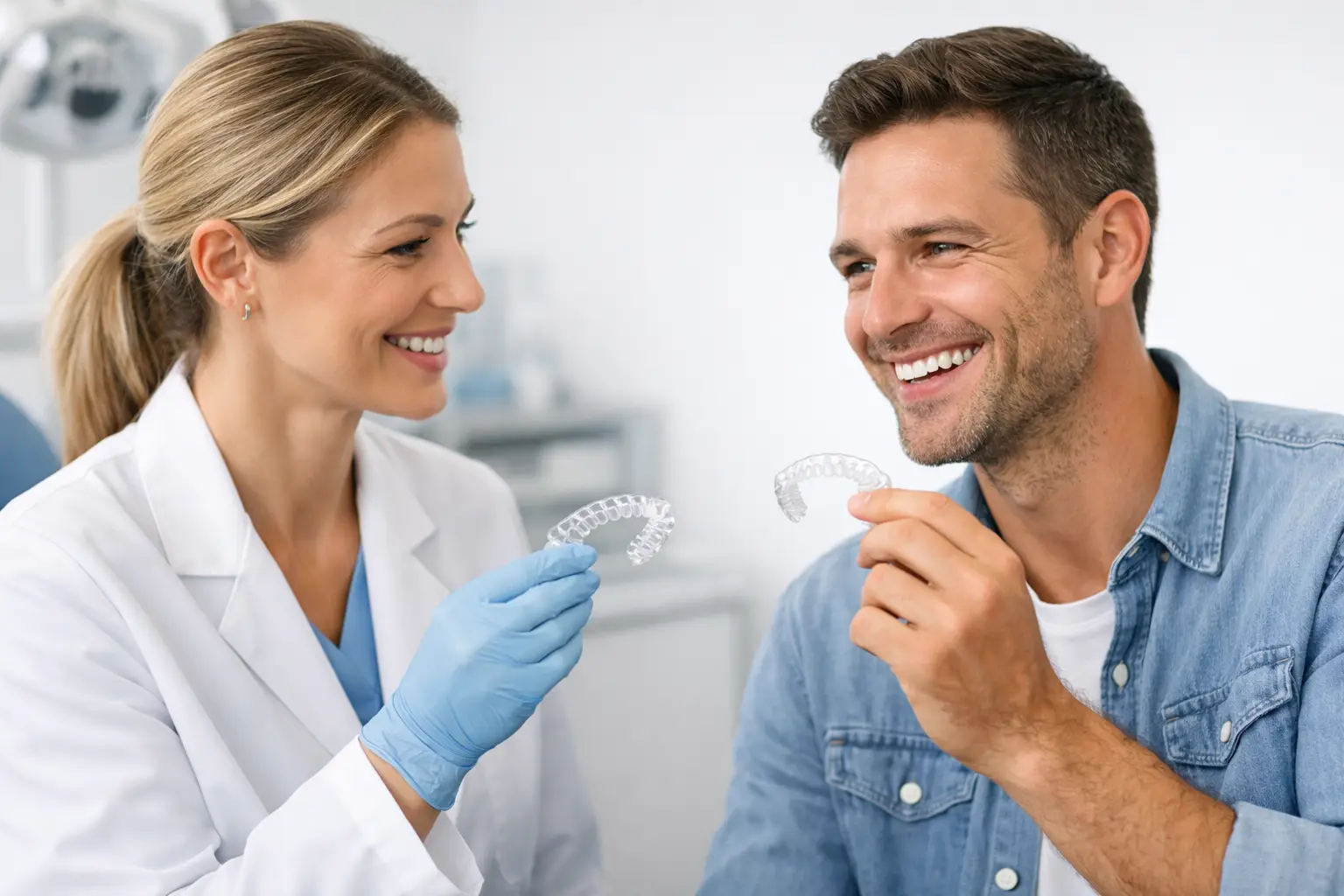
An overbite rarely announces itself with one obvious symptom. For some people, it shows up in photos as upper teeth that seem to dominate the smile. For others, it feels more functional – uneven wear, jaw strain, lip tension, or front teeth that take more pressure than they should. That is why clear aligners for overbite correction have become such a compelling option. They do more than straighten visible crowding. In the right case, they can help improve how the bite fits together while keeping treatment discreet, comfortable, and highly controlled.
The key phrase there is in the right case. Overbite correction is not a cosmetic shortcut. It is a biomechanical problem that needs a precise plan, because the goal is not simply to move teeth back and forth until they look better. The real objective is to create a more balanced relationship between the upper and lower arches, ideally with support for long-term function, stability, and appearance.
What clear aligners for overbite correction actually treat
An overbite refers to how much the upper front teeth overlap the lower front teeth vertically. A mild overlap is normal. The issue starts when that overlap becomes excessive or contributes to instability, wear, or a bite that does not function efficiently.
Not every overbite looks the same. In one patient, the front teeth may be deeply covered because the teeth themselves have erupted in a certain pattern. In another, the arches may be positioned in a way that reflects a broader jaw relationship. That distinction matters, because aligners move teeth very well, but the quality of the result depends on whether tooth movement alone can solve the problem or whether the case also involves a significant skeletal component.
This is where modern digital orthodontics has changed expectations. Clear aligners are no longer limited to simple alignment in mild cosmetic cases. With advanced planning, controlled force systems, attachments, elastics in selected cases, and scan-based monitoring, they can address many overbites with a level of precision that was harder to deliver consistently in the past.
How overbite correction with aligners works
Clear aligner treatment for overbite correction usually relies on a combination of movements rather than one dramatic shift. Depending on the case, the treatment may intrude certain front teeth, extrude selected posterior teeth, retract anterior segments, coordinate arch form, or improve the angulation of the incisors so the bite closes more harmoniously.
That sounds technical, but the patient experience is straightforward. You wear a sequence of custom aligners that are engineered to create small, progressive movements. Each stage is mapped digitally in advance, then checked throughout treatment to confirm that the teeth and bite are responding as expected.
The reason this matters in overbite cases is simple. Vertical correction is sensitive. If the plan is too aggressive, too generic, or insufficiently monitored, the bite can look improved without actually becoming more stable. Precision is what separates a polished aligner result from one that only appears successful at first glance.
Why case selection matters so much
One of the biggest misconceptions in orthodontics is that every bite problem can be fixed equally well with every appliance. That is not true. Clear aligners can be excellent for overbite correction, but they are not magic.
A mild to moderate dental overbite is often very treatable with aligners when the arches, tooth positions, and patient compliance all support that plan. More complex cases may still be candidates, especially when treatment includes advanced digital planning and a system designed to guide function as well as alignment. But there are limits. If the overbite is driven heavily by jaw structure, facial growth pattern, or severe skeletal discrepancy, treatment decisions become more nuanced.
That does not automatically mean braces are better. It means the diagnosis needs to be better. The best providers do not ask whether aligners are trendy or convenient. They ask whether they can deliver controlled, predictable correction for your exact bite.
The benefit adults and teens care about most
For most patients, the first appeal is obvious – clear aligners are discreet. Adults in professional settings and teens who do not want visible brackets are drawn to the clean, low-profile look. But for overbite correction, discretion is only part of the value.
Comfort, removability, and digital predictability make a real difference over the course of treatment. Aligners let patients eat normally, brush thoroughly, and move through work, school, and social life with less disruption. That convenience tends to improve consistency, and consistency is a major factor in outcome quality.
There is also a psychological advantage. When patients can see a digitally planned path and monitor real progress, treatment feels less abstract. You are not just waiting for a future smile. You are following measurable changes in real time.
Where digital tracking changes the standard
This is one area where premium orthodontic systems stand apart. In overbite cases, progress should not be judged only by whether the trays fit or whether the front teeth appear straighter. The bite, arch relationship, and jaw position all deserve attention throughout treatment.
A digitally driven workflow makes that possible. With high-resolution scans and superimposed tracking, clinicians can compare changes over time rather than relying on visual estimates alone. That level of monitoring helps identify when treatment is progressing on target and when refinement may be needed.
For patients, this translates into something tangible – more confidence in the process. Instead of hoping the bite is improving, you can see objective evidence of movement and alignment. In a system like MYSS, where aligner therapy can be paired with SyncSplint jaw synchronization and 3DDA scan-based tracking, the treatment experience becomes more comprehensive. The focus is not only on straighter teeth, but on a more coordinated bite and a more predictable path to stability.
Can clear aligners fix every overbite?
No, and any honest answer should start there.
Some overbites respond very well to aligners. Others improve partially but may require additional mechanics or a different treatment strategy to reach the ideal result. The variables include age, severity, tooth anatomy, periodontal health, jaw relationship, airway considerations, parafunctional habits, and how consistently the aligners are worn.
Compliance is especially important. Clear aligners only work when they are in your mouth for the recommended number of hours each day. In overbite correction, where timing and force control matter, inconsistent wear can slow progress or compromise the movement sequence. Patients who want the freedom of a removable appliance also need the discipline to use it properly.
That trade-off is worth being clear about. Aligners offer flexibility. They also require commitment.
How long treatment usually takes
There is no universal timeline, because overbite correction is not one-size-fits-all. A mild case may move efficiently within a relatively moderate treatment window. A more involved case with vertical, sagittal, and functional considerations may take longer and include refinement phases.
What patients often miss is that speed should never be the only goal. Rapid tooth movement that ignores the bite can create short-term excitement and long-term frustration. A better benchmark is efficient progression with stable control.
When treatment is planned with detailed digital diagnostics and monitored consistently, timelines tend to become more realistic and outcomes more dependable. That is a far better experience than being given an overly optimistic estimate that does not account for how your bite actually behaves.
What to ask before starting treatment
If you are considering clear aligners for overbite correction, ask how your overbite is being measured, what type of movements are required, and how progress will be monitored beyond basic tray fit. Ask whether the treatment is focused only on straightening teeth or also on improving bite function. Ask what happens if refinement is needed.
These questions matter because premium orthodontic care should feel transparent, not vague. The best treatment plans are specific. They explain what is changing, why it is changing, and how that change will be verified over time.
A polished smile is part of the result. A better-functioning bite is what helps that result last.
Is it the right option for you?
If you want a discreet, modern alternative to braces and your overbite is treatable through controlled aligner mechanics, the answer may be yes. For many adults and teens, aligners offer a powerful balance of aesthetics, comfort, and precision. When that treatment is supported by advanced scanning, functional planning, and ongoing digital assessment, the experience becomes even more compelling.
The smartest next step is not guessing based on photos or social media before-and-afters. It is getting a diagnosis that looks at the full picture – teeth, bite, jaw coordination, and long-term stability. When that foundation is strong, clear aligners can do far more than improve your smile. They can move you toward a result that feels just as good as it looks.
Comments are closed