
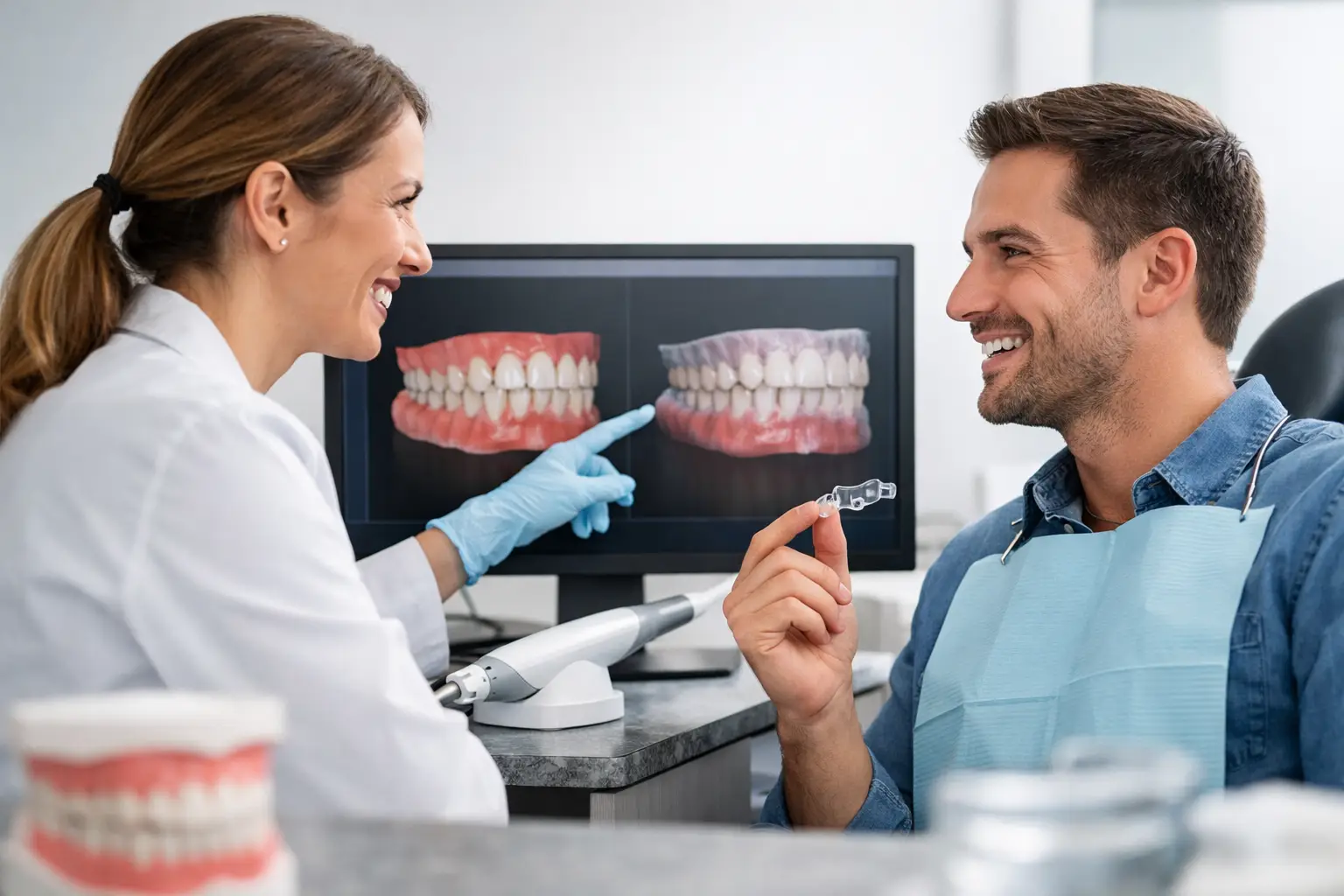
You can feel your smile changing long before you can prove it. That gap between what you notice and what your orthodontist can measure is exactly where 3d orthodontic scan tracking changes the experience. Instead of relying on snapshots, estimates, or a quick visual check, this approach uses digital scans over time to show how teeth, arches, and jaw relationships are actually moving.
For patients choosing a premium orthodontic path, that shift matters. Straighter teeth are only part of the result. Comfort, bite balance, jaw function, treatment efficiency, and long-term stability all depend on whether progress is being tracked with enough precision to guide decisions early, not after a problem becomes obvious.
What 3D orthodontic scan tracking actually measures
At its core, 3D orthodontic scan tracking compares a series of digital intraoral scans taken at different stages of treatment. Those scans are superimposed so your doctor can evaluate change over time rather than judging each appointment in isolation.
That sounds technical, but the benefit is simple. Instead of hearing that your teeth “seem to be moving well,” you can see whether specific teeth are tracking according to plan, whether arch form is changing as expected, and whether bite relationships are improving in a stable way.
The most advanced systems go further than monitoring crown position alone. They can help assess how the dental arches relate to one another and how jaw position is evolving during treatment. That matters because an attractive smile and a functional bite are not separate goals. When orthodontics ignores function, cosmetic improvements can come with compromise. When treatment accounts for both, outcomes are more balanced and more predictable.
Why scan tracking is different from traditional progress checks
Traditional orthodontic monitoring still has value. A skilled doctor can learn a great deal from a clinical exam, photos, and the patient’s feedback. But there are limits to what the eye can catch between visits, especially when movement is subtle or when several changes are happening at once.
3D orthodontic scan tracking adds objectivity. It creates a digital record of progress that can be revisited, compared, and measured. If a tooth is lagging behind the planned movement, that deviation can be identified sooner. If the arches are developing well but the bite is not settling as expected, the treatment plan can be refined before lost time adds up.
This does not mean every scan leads to a major adjustment. Often, the value is in confirming that things are progressing efficiently. For patients, that confidence is powerful. You are not just hoping your treatment is on course. You have visible evidence.
The patient experience is simpler than most people expect
Many people hear the word “tracking” and assume it means more appointments, more complexity, or more discomfort. In practice, digital scan-based monitoring is usually far easier than traditional impressions and much more comfortable.
A scan captures detailed images of your teeth and bite without messy materials or trays. Once those records are stored, they can be compared throughout treatment to build a time-based picture of change. For busy adults, teens with packed schedules, and anyone who values convenience, that digital workflow feels more aligned with modern care.
It also changes the conversation at appointments. Instead of a vague update, you can review measurable changes. You can ask better questions. You can understand why a refinement, an attachment adjustment, or a shift in wear protocol might be recommended. That transparency tends to improve trust because treatment no longer feels like a black box.
Where precision matters most
Not every orthodontic case requires the same level of intervention. A mild cosmetic alignment case may progress with relatively few changes. A more complex case involving bite issues, arch coordination, or jaw imbalance requires closer control.
This is where 3D orthodontic scan tracking becomes especially valuable. It helps distinguish between movement that looks acceptable on the surface and movement that supports a more stable final result. A patient may care most about how their smile looks in photos, but the biology of treatment still depends on force control, timing, and functional balance.
For example, if front teeth appear straighter but posterior bite support is not developing properly, the treatment may need refinement. If tooth movement is progressing but jaw coordination is not improving, the visual result may still fall short of the functional one. Precision matters because small discrepancies, left unaddressed, can influence comfort, efficiency, and retention later.
Tracking teeth alone is good. Tracking function is better.
One of the biggest limitations in conventional aligner treatment is the assumption that moving teeth into line is enough. In many cases, it is not. Teeth live inside a system that includes the jaws, joints, muscles, and bite. If those relationships are ignored, treatment can become slower, less predictable, or less stable over time.
That is why a more advanced digital ecosystem stands out. MYSS combines clear aligners, SyncSplint jaw synchronization, and 3DDA scan-based monitoring to follow not only dental alignment, but the broader mechanics of the stomatognathic system. For the patient, that means your treatment is not being judged only by whether the trays fit. It is being evaluated by whether your smile, bite, and jaw relationship are progressing together.
This distinction matters for people who want more than a cosmetic touch-up. If you have concerns about bite imbalance, jaw position, treatment length, or long-term stability, a function-aware tracking model offers a more complete view of progress.
What 3D scan tracking can improve during treatment
The practical value shows up in several ways. First, it can support earlier intervention. When a tooth is not tracking properly, catching it quickly may reduce delays and limit the need for more extensive refinements later.
Second, it can improve predictability. Orthodontic treatment is biological, so no system can make movement perfectly uniform in every patient. But better monitoring allows the plan to adapt based on real response rather than assumptions.
Third, it can support efficiency. If treatment is progressing as intended, digital confirmation helps avoid unnecessary changes. If it is not, corrections can be made with more confidence. Both scenarios can save time.
Fourth, it creates a stronger long-term record. That matters not only during active treatment but also after it. Retention is where many orthodontic results are either protected or slowly lost. Digital records make it easier to monitor stability over time and respond before relapse becomes significant.
Is 3D orthodontic scan tracking worth it for every patient?
For most modern orthodontic patients, yes, but the reason varies. If you are focused on aesthetics, tracking gives you a clearer picture of how your smile is progressing. If you are concerned about comfort and bite function, it helps your doctor monitor changes more comprehensively. If you are investing in premium care, it adds the level of accountability and documentation you would expect.
That said, the value is highest when the tracking system is integrated into a well-designed treatment philosophy. Technology alone does not create a better outcome. A scan is only as useful as the clinical decisions built around it. That is the trade-off patients should understand. The best experience comes from pairing precise data with a treatment model that knows how to use it.
What to ask before starting treatment
If a provider offers digital scanning, ask how those scans are used after the initial consultation. Are they simply for making aligners, or are they used to compare progress over time? Ask whether the system tracks only tooth alignment or also evaluates arch and bite relationships. Ask how often progress is reviewed digitally and what happens if your movement starts to differ from plan.
These questions are not about chasing technology for its own sake. They are about understanding whether your treatment will be monitored at the level your goals deserve. A discreet appliance is appealing. A faster timeline is appealing. But measurable progress, guided with precision, is what turns those promises into a result you can trust.
The smartest orthodontic treatment does more than move teeth. It shows you, with clarity, that every change is moving in the right direction.
Comments are closed